Two client stories, one truth: the businesses winning in AI search aren't the ones who did the work once. They're the ones who keep doing it.
When people hear "AEO" (Answer Engine Optimization), they picture a project. Something with a start date and an end date. You do the work, check it off the list, move on.
That's not how it actually works — and two client accounts this year showed me exactly why.
I keep a close eye on results after the initial work is done, which means running regular check-ups on client sites to make sure everything's still current. Between those check-ups and a rule change Google made in May 2026, two projects this year — one for a Maui fragrance gallery, one for a Kīhei gift shop — made it clear just how much things can shift after the "finish line."
Here's what actually happened.
When someone asks ChatGPT, Perplexity, or Google's AI Overview a question like "where can I buy locally made gifts on Maui," the AI doesn't magically know the answer. It reads your website, figures out what you sell, and decides whether you're worth recommending.
AEO is the work of making that easy for it — organizing your website's information so an AI tool can understand it clearly enough to recommend you by name. Think of it as translating your business into a language machines can read, the same way good signage and clear pricing help a human customer understand your business at a glance.
That's the whole idea. Now, here's why it's never really "done."
Months ago, I did this translation work across the entire product catalog for Bootzie, owner of Enchantress & Freeborne Gallery — going page by page so AI tools could clearly understand what each Tropical Fragrance product was and who it was for.
Job done. Or so I thought.
A routine check-up on the account turned up something I didn't expect: the work needed to be redone in places. Not because anyone had dropped the ball — because her catalog itself had grown and changed since the original build. New language, new products, new pages. And that kind of behind-the-scenes setup doesn't update itself. It just quietly falls out of sync with the business it's supposed to describe.
Then, mid-fix, Google shut down a feature called "FAQ rich results" industry-wide — the little expandable Q&A dropdowns that used to show up in search results.
For a business that had been chasing that Google feature specifically, this would have been a dead end. But it was actually the moment the real story clicked into focus: the goal was never that Google dropdown. The goal was making sure an AI assistant — ChatGPT, Perplexity, Gemini — can actually read a product page, understand what it's selling, and recommend it to someone who asks.
The Google feature disappeared. The underlying need didn't. If anything, it got more important.
The second story is Ellie Salazar's shop, Tutu's Pantry. Different problem, same lesson.
Tutu's Pantry carries 613 products, and getting AI tools to represent that inventory accurately meant ongoing work: keeping product details accurate and complete across the whole catalog, adding spice-level information item by item, and steadily building out recipe information so AI tools understand not just what a product is, but how it's actually used.
None of that is a one-time task. It's maintenance — the same way you don't set up your website analytics once and never check them again.
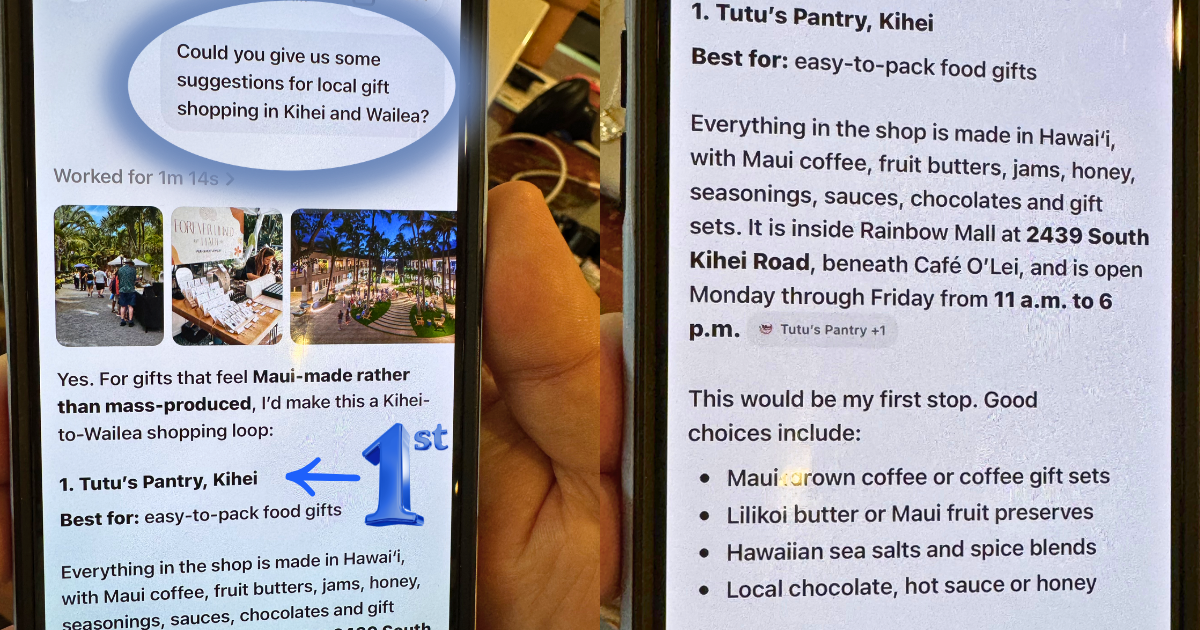
Here's the payoff: a customer found Tutu's Pantry through ChatGPT, saw it recommended for locally made gift items, and drove 51 minutes to visit the shop in person. She wasn't searching for the business by name. She asked an AI assistant a question, and the shop's own information — kept current, kept accurate — is what got her there.
That's not a search feature. That's a sale.
Bootzie's project shows the maintenance side of AEO: the setup can drift out of date as a business grows, and platforms can change their rules without warning. What worked a year ago can quietly stop working — not from neglect, just from time passing.
Ellie's project shows the other side: the ongoing value of good, current information — the kind that lets an AI assistant confidently recommend a real product to a real person, at the exact moment they're deciding where to spend money.
Different businesses. Different maintenance needs. Same underlying truth: AEO isn't something you finish. It's infrastructure you maintain.
AI tools are constantly re-reading and re-evaluating businesses on their own schedule — not yours. The businesses that stay visible in AI search aren't the ones with the best one-time setup. They're the ones whose information keeps earning that visibility, month after month.
If it's been a while since anyone looked at how your business shows up to AI tools, it's worth asking:
You don't need to overhaul everything. You need a system that checks in regularly — the same instinct that has you glancing at your website analytics or your Google Business Profile every so often, applied to how AI assistants see your business.
That's the shift I'd encourage: stop thinking of AI visibility as a project with an end date, and start thinking of it as a standing part of how your business stays findable — by people, and increasingly, by the AI tools people are asking instead.
Ready to Take Action?
Have a question about whether your site is still showing up accurately to AI tools like ChatGPT? Let's talk it through — no pitch, no pressure.
Start a Conversation →Free · No pressure · We respond within one business day